

Soakaway Installation, Replacement and Repair
Surface water that doesn't drain away, a waterlogged garden, or building regulations requiring soakaway drainage for an extension. We install soakaways that work properly for your specific ground conditions and site.
Your Local Drainage installs, replaces, and repairs soakaways across England and Wales. Every installation is preceded by a percolation test to confirm the ground can accept the drainage load.
24/7 Availability
No Call-Out Charge
1-Hour Response
Up to 10-Year Guarantee
10% Discount Blue Light & Senior Citizens
What a Soakaway Does and When You Need One
A soakaway is an underground structure that receives surface water or clean rainwater run-off and allows it to percolate slowly into the surrounding ground.
The most common reasons to install one:
New build or extension requiring building regulations compliance for surface water drainage
Replacement of a failed or full soakaway no longer accepting water
Garden or driveway waterlogging caused by inadequate or absent drainage
Soakaway serving a septic tank or treatment plant that needs replacing
Planning approval condition requiring surface water disposal on-site
Types of Soakaway We Install
Plastic crate soakaways
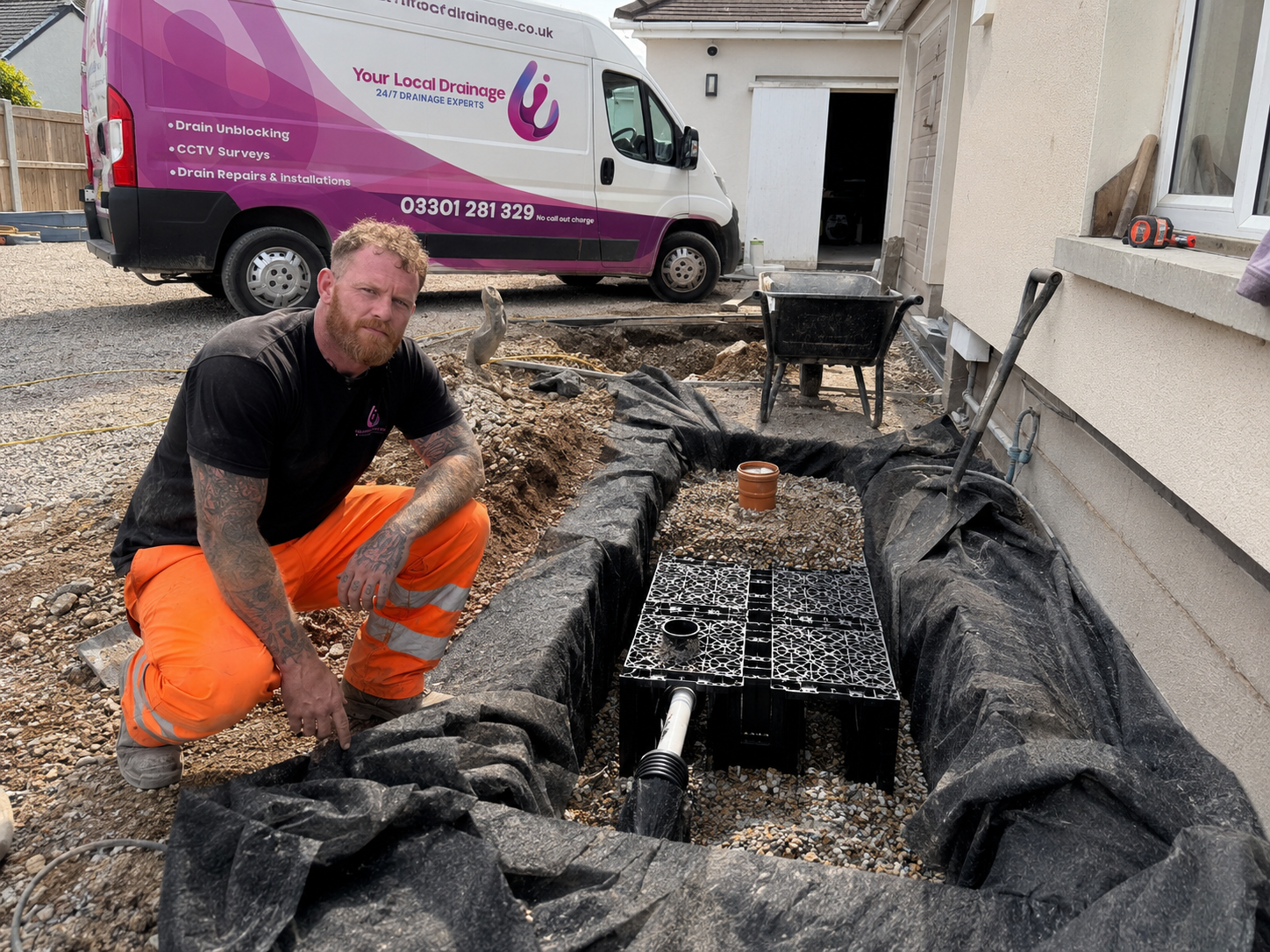
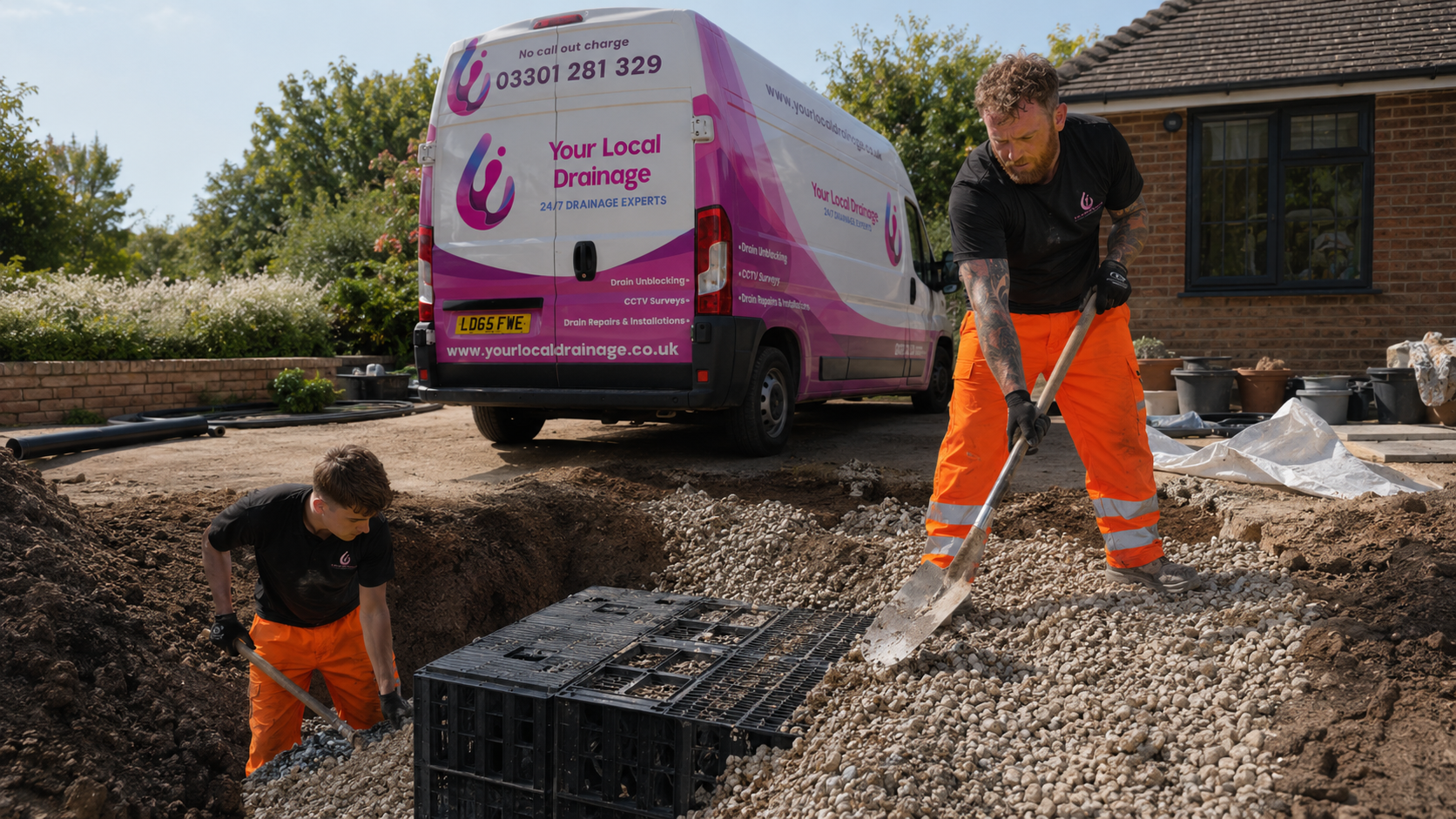
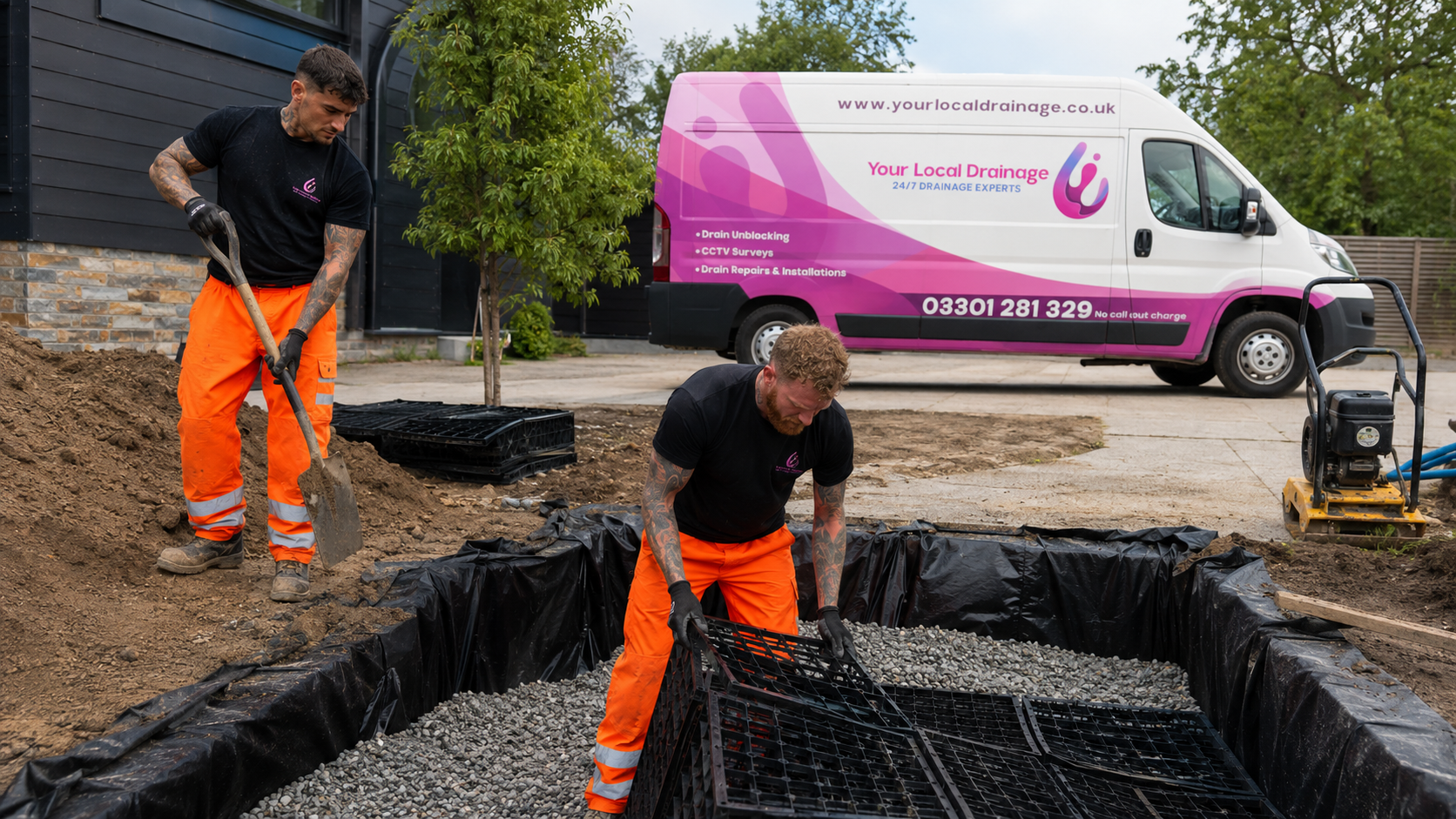
The current standard for new installations. A modular plastic crate system wrapped in geotextile membrane provides high void capacity in a compact footprint. Better than rubble for calculating void capacity accurately and confirming building regulations compliance.
Rubble soakaways
A traditional pit filled with clean hardcore or rubble and covered with geotextile. Still appropriate in some circumstances, particularly for replacing like-for-like in older systems.
French drains
A perforated pipe set in a gravel-filled trench, used to intercept and redirect surface water across a linear run. Often used in combination with a soakaway at the outlet end.
Soakaways for septic tanks
A dedicated soakaway or drainage field receiving treated effluent from a septic tank or small sewage treatment plant. Sized and installed to Environment Agency and building regulations requirements.
How We Install a Soakaway
1.
Percolation test
Before any soakaway is installed, we carry out a percolation test to establish how quickly water drains through your soil. This determines the size and type required. Without a percolation test, there's no way to know whether the ground can accept the drainage load.
2.
Design and sizing
The soakaway is sized to the drainage area it serves, the percolation rate, and any building regulations requirements.
3.
Excavation
The pit is excavated to the required dimensions, usually by hand around existing services or by machine where access allows.
4.
Installation
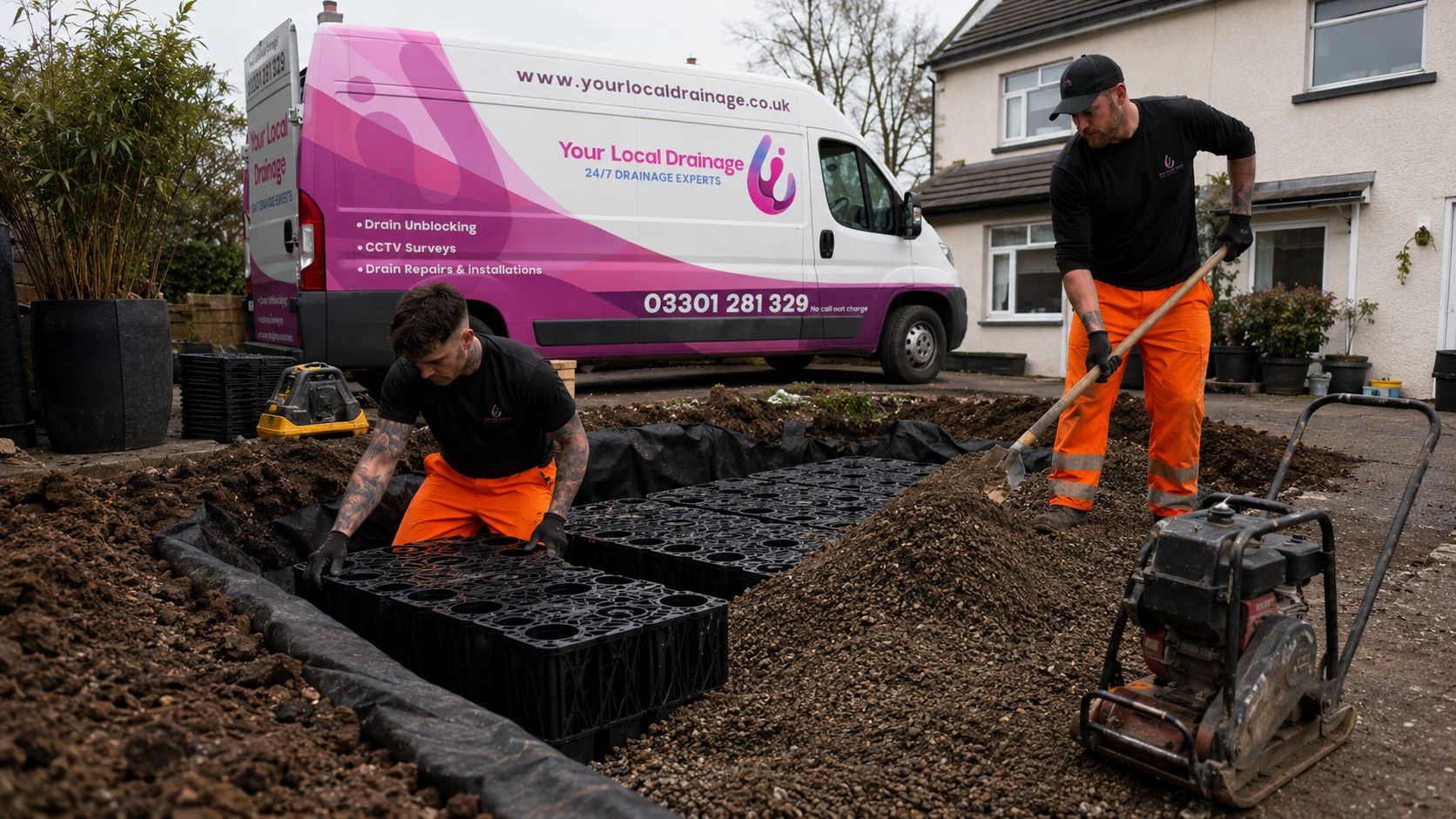
The crate system or rubble fill is installed with geotextile membrane and the inlet pipe connected.
5.
Backfill and reinstatement
The excavation is backfilled, compacted, and the surface reinstated. We take care with driveways, lawns, and paved areas.
Soakaway Repair and Replacement
Soakaways fail over time. The surrounding soil becomes saturated, the void fills with silt, or the structure collapses. A failed soakaway usually presents as surface water that no longer disappears after rain.
We assess failed soakaways with a CCTV survey of the inlet pipe and a test of the surrounding soil. Where the soakaway structure has failed, we replace rather than repair, a failed soakaway can't usually be restored to working condition by cleaning alone.
Coverage
We're based in Bournemouth and cover a wide area across England and Wales.
Core Areas
Emergency & Planned Work
Dorset - BH, DT
Hampshire - SO, PO
Wiltshire - SP, SN, BA
Somerset- BA, TA
Berkshire - RG, SL
Extended Area
Emergency & Planned Work
Oxfordshire - OX
Surrey - GU, RH
West Sussex - PO, BN
Devon - EX
Monmouthshire - NP
Warwickshire - CV
South Wales - NP, CF
Buckinghamshire - MK, HP
Worcestershire - WR
Cheshire - SK, CW
Further Reach
Planned Work
Gloucestershire - GL
Herefordshire - HR
East Sussex - BN, TN
Northamptonshire - NN
Bedfordshire - LU, MK
Hertfordshire - AL, WD
Gtr Manchester - M, SK
Merseyside - L, CH
Not sure if you're covered?
Call 0330 128 1329 with your postcode — we'll tell you straight away.
FAQS
Soakaways — Common Questions
How much does soakaway installation cost?
Do I need planning permission for a soakaway?
Planning permission is not usually required for a soakaway serving a dwelling. However, building regulations approval is required for new drainage associated with extensions or new builds. Soakaways for septic tanks must comply with Environment Agency guidance.
How do I know if my ground is suitable for a soakaway?
A percolation test establishes how quickly your soil absorbs water. Soakaways work well in sandy, chalky, and well-drained soils. Heavy clay may not support a soakaway — alternative drainage solutions may be needed.
How long does a soakaway last?
A properly installed soakaway in suitable soil should last 20–30 years or more. Failure is usually caused by the surrounding soil becoming saturated over time or silt build-up in the void.
What's the difference between a soakaway and a French drain?
A soakaway is an underground void that holds water and releases it slowly into the surrounding soil. A French drain is a trench filled with gravel and perforated pipe that intercepts and redirects surface water. They're often used together.